
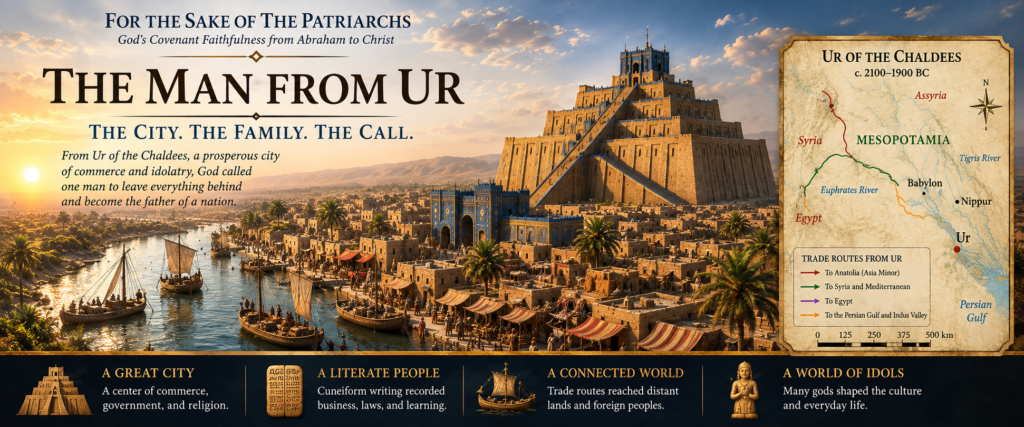
Long before Abraham pitched his tent beneath the stars of Canaan, he walked the bustling streets of one of the ancient world’s great cities.
Ur stood in southern Mesopotamia, near the lower reaches of the Euphrates River in what is now southern Iraq. Around the beginning of the second millennium BC, it was a thriving center of commerce, government, religion, and learning. Far from being an isolated settlement, Ur was a prosperous metropolis connected by trade routes stretching across the ancient Near East and beyond.
Its streets were lined with mudbrick homes, workshops, and marketplaces crowded with merchants, craftsmen, scribes, and laborers. Goods from distant lands flowed into the city—timber, metals, precious stones, textiles, and other valuable commodities arriving through an extensive network of waterways and overland trade.
Archaeology has revealed just how sophisticated this society was. Thousands of clay tablets preserve business transactions, contracts, tax records, legal disputes, and commercial accounts, all recorded in cuneiform. Excavated homes and streets reveal an organized urban community, while imported materials testify to trading connections reaching as far as Afghanistan, the Persian Gulf, and the Indus Valley.
Towering above it all stood Ur’s most recognizable landmark—the great ziggurat dedicated to Nanna, the moon god. Rising in massive stepped terraces, it dominated the skyline and served as a constant reminder that religion permeated nearly every aspect of life. The city’s economy, government, festivals, and daily routines were closely connected to its temples and priests. Idolatry was not simply practiced in Ur; it was woven into the fabric of society.
He did not grow up among scattered tents in a barren wilderness. Nor was he raised among the descendants of Moses or David, for the nation of Israel did not yet exist. Abraham came from a highly developed pagan civilization surrounded by wealth, learning, commerce, and the worship of many gods.
Even his own family appears to have shared in that culture’s idolatry. Centuries later, Joshua would remind Israel:
“Your fathers… lived beyond the River and served other gods” (Joshua 24:2).
Everything familiar to Abraham—family, language, culture, security, prosperity, and religion—was rooted in this world. Yet it was from this sophisticated and comfortable civilization that God called one man to leave behind everything he knew and journey toward a land he had never seen.
That makes the call of Abraham far more striking. He was not simply being asked to move from one campsite to another. He was being called away from one of the great centers of civilization and, ultimately, away from the religious world into which he had been born.
Ur offered Abraham prosperity, familiarity, and security. God offered him a promise.
To understand why that promise required such extraordinary faith, however, we must first look more closely at the family into which Abraham was born. For the story of God’s call begins before Abram ever set foot on the road to Canaan.
The Call →
Follow the Journey
Receive each new article in For the Sake of the Patriarchs by email.