
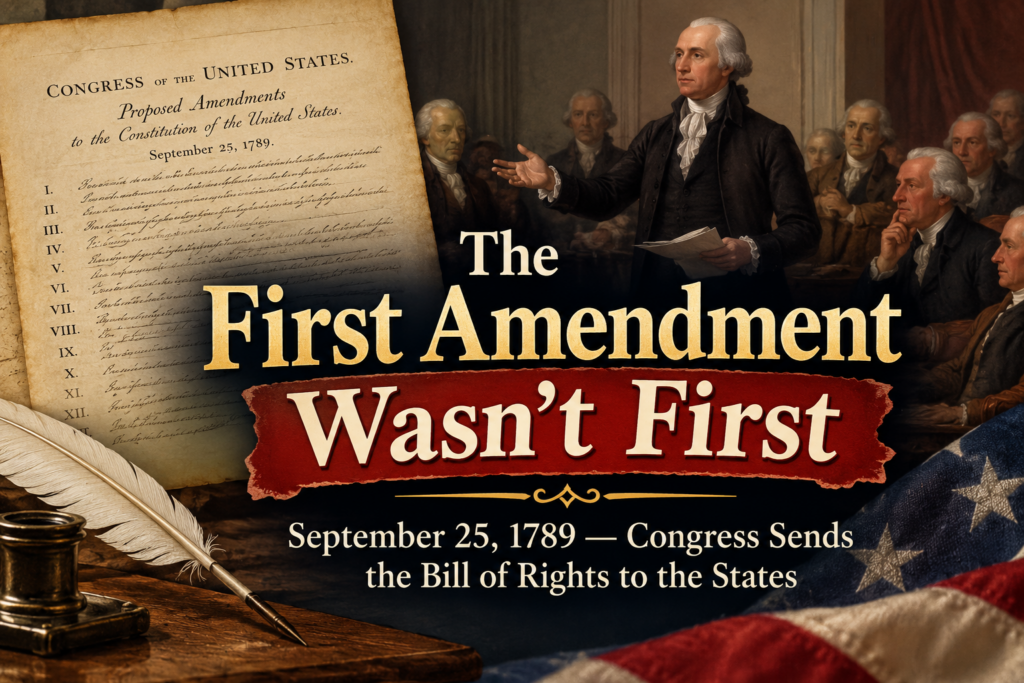
September 25, 1789 — The Bill of Rights Was Sent to the States
When we think of the Bill of Rights, we think of ten amendments.
Freedom of religion. Freedom of speech and the press. The right to keep and bear arms. Protection against unreasonable searches. Trial by jury. Powers reserved to the states and the people.
But on September 25, 1789, Congress did not send ten amendments to the states.
It sent twelve.
The story began with a concern left unresolved when the Constitution was written.
The delegates in Philadelphia had created a stronger federal government, but the Constitution contained no separate declaration protecting individual liberties. During the ratification debates, critics argued that fundamental freedoms should be explicitly protected, and several states recommended amendments.
James Madison had initially questioned whether a bill of rights was necessary. The federal government, after all, possessed only the powers granted to it by the Constitution. But he came to recognize the value of placing certain protections beyond dispute.
On June 8, 1789, Madison introduced a series of proposed amendments in the House of Representatives. The House eventually approved seventeen. The Senate revised them, and after the two chambers reconciled their differences, twelve remained.
On September 25, Congress sent those twelve to the states.
The First Amendment Wasn’t First
Here the story becomes particularly interesting.
The amendment we now call the First Amendment was actually third on the original list.
The first proposed amendment concerned the size of the House of Representatives. It was never ratified.
The second concerned congressional pay. It prohibited a change in congressional compensation from taking effect until after an intervening House election. It also failed to receive enough ratifications at the time.
But it didn’t disappear.
More than two centuries later, in 1992, it was finally ratified as the Twenty-Seventh Amendment.
That left proposed amendments three through twelve.
Those became the ten amendments we know today as the Bill of Rights.
“To Prevent Misconstruction or Abuse”
Perhaps the most revealing words from September 1789 were contained in the introduction Congress sent with the amendments.
Additional protections, Congress explained, would help “prevent misconstruction or abuse of its powers” and increase public confidence in the government.
That phrase captures something fundamental about the Bill of Rights.
The Founders were creating a government powerful enough to govern, but they were also conscious that governmental power could be abused.
Consider the language they chose:
“Congress shall make no law…”
“…shall not be infringed.”
“…shall not be violated.”
And finally, powers not delegated to the United States were reserved to the states or “to the people.”
The Bill of Rights was therefore more than a list of things Americans were permitted to do. Again and again, its language established boundaries on federal power and protected rights retained by the people.
September 25 Was Only the Beginning
The amendments did not become part of the Constitution that day. Ratification by three-fourths of the states was still required.
That came on December 15, 1791, when Virginia supplied the necessary ratification. Ten of the twelve proposals became part of the Constitution.
More than 230 years later, those amendments remain central to American debates over religion, speech, the press, firearms, due process, the rights of the accused, the powers of the states, and the rights of the people.
But September 25, 1789, leaves us with an even more fundamental thought.
The men establishing America’s new government were not merely asking:
What powers does government need?
They were also asking:
What powers should government never be allowed to exercise?
Their answer became the Bill of Rights.