
Most of us believe in free speech.
At least, we believe in it until someone says something we find offensive, dishonest, dangerous—or simply wrong.
That is when the principle becomes difficult.
It costs us nothing to defend someone making our argument or affirming our view of the world. The real test of free speech comes when someone is saying something we would rather not hear.
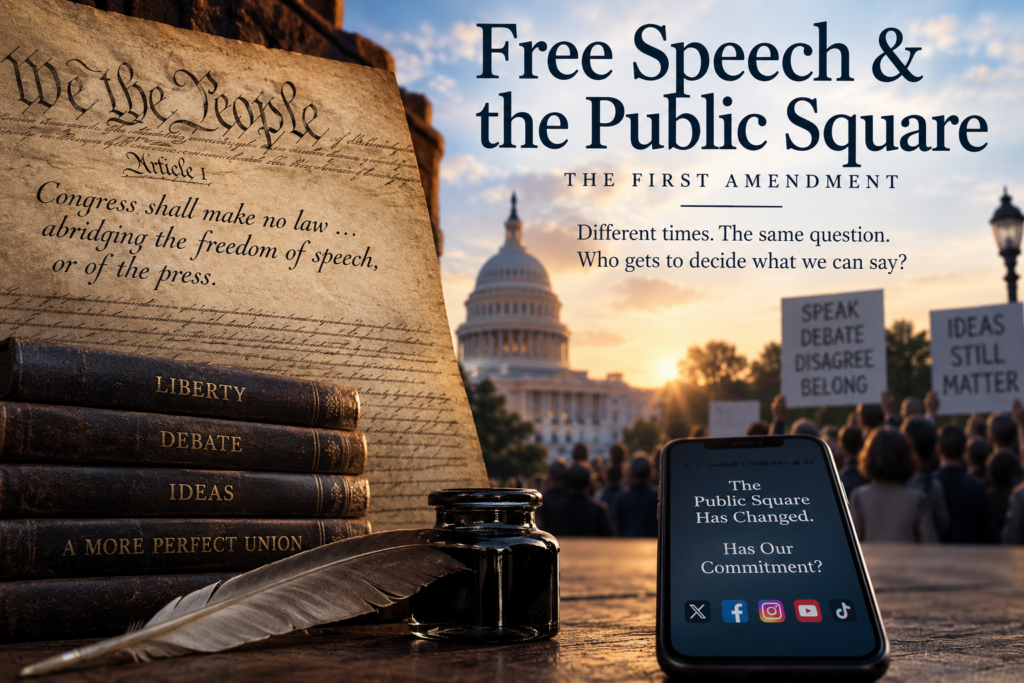
The Founders understood the temptation of those entrusted with power to decide which ideas were acceptable and which were not. That is why the First Amendment begins not by granting Americans permission to speak, but by restricting government:
“Congress shall make no law … abridging the freedom of speech, or of the press.”
Yet it didn’t take long for that principle to be tested.
Only seven years after the Bill of Rights was ratified, with tensions rising between the United States and France, the Federalist-controlled Congress passed the Alien and Sedition Acts. The Sedition Act made it a crime to publish “false, scandalous and malicious” writings against the federal government, Congress or the President. Opposition newspaper editors were among those prosecuted. (National Archives)
The government had an argument. The young nation faced international tension, bitter political division and fears of foreign influence.
Its opponents had an argument too: if government could determine which criticism of government was dangerously false, what remained of freedom of speech and the press?
James Madison warned that restricting the ability of the people to examine public officials and government measures threatened a right that served as a guardian of other rights. (Founders Online)
More than two centuries later, the public square looks very different.
Today it fits in our pocket.
Social media allows an ordinary citizen to reach an audience that would be unimaginable in 1791. The Supreme Court recognized this transformation in Packingham v. North Carolina (2017), describing social media as an important arena for “speaking and listening in the modern public square.” (Supreme Court)
But there is a complication.
Much of this new public square is privately owned.
The First Amendment generally restricts government, not private companies simply because they provide a forum for speech. And the Supreme Court has recognized that social-media companies can have First Amendment interests of their own when deciding what material to include, exclude or organize. (Supreme Court)
Then comes perhaps the more difficult question.
What happens when government becomes involved in what those private platforms allow?
In Murthy v. Missouri (2024), the Supreme Court considered a challenge involving communications between federal officials and social-media companies over content moderation. The Court ultimately decided that the plaintiffs had not established the standing necessary for the injunction they sought, leaving the broader constitutional boundary unresolved in that case. (Supreme Court)
And so an old question has returned in a remarkably modern form:
When does government persuasion become government coercion?
Technology has changed beyond anything Madison could have imagined. The underlying temptation has not.
Governments worry about misinformation, foreign influence, public safety and political instability. Some of those concerns can be very real. But the history of the First Amendment reminds us why the power to control political expression deserves particular scrutiny.
The First Amendment has never meant that every form of expression is protected in every circumstance. American law recognizes limited categories of unprotected speech, including true threats, legally defined obscenity and certain incitement. But those exceptions do not erase the larger principle: government power over political expression remains deliberately constrained.
Which leaves us with two uncomfortable questions:
Who gets to decide what Americans are allowed to say?
And perhaps more importantly:
Are we prepared to defend the freedom of someone whose words we deeply dislike?
Because if free speech protects only ideas we already approve of, it ceases to be a freedom in any meaningful sense.