
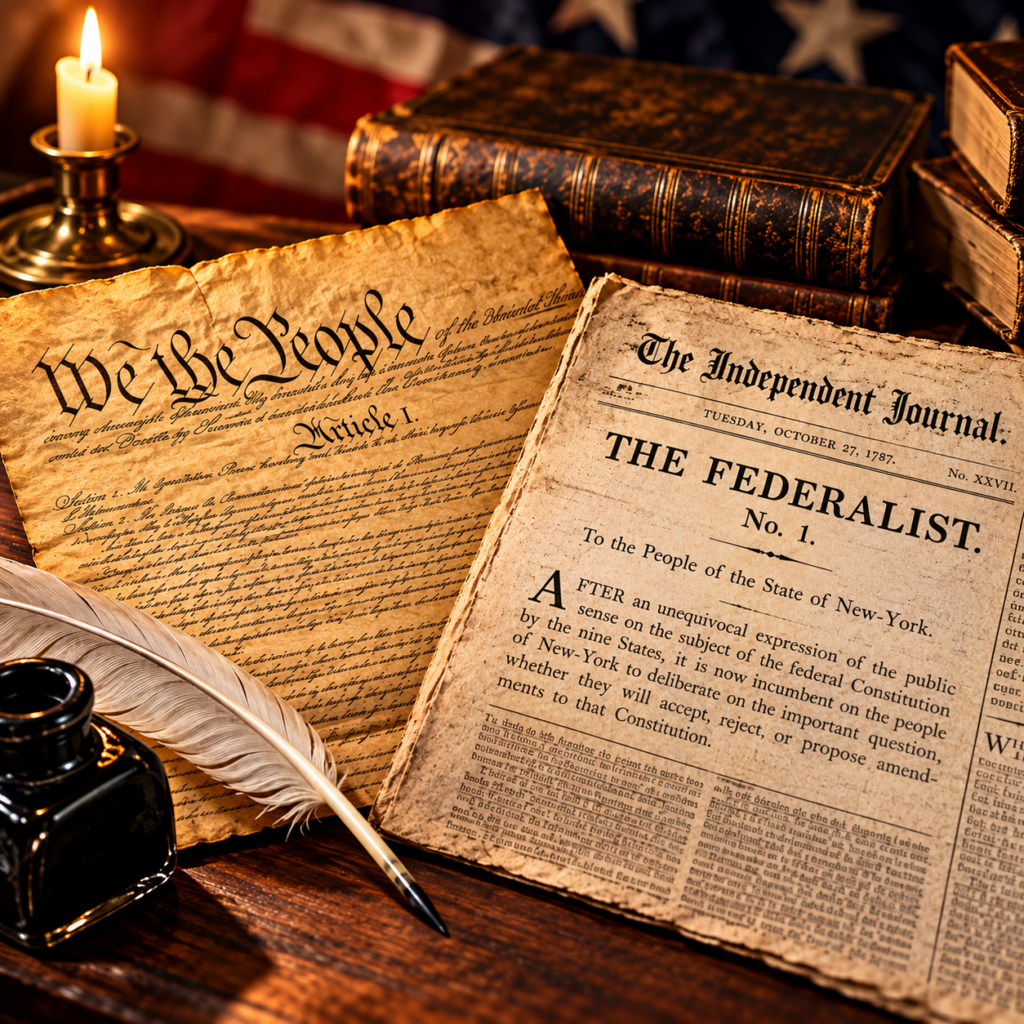
This Week in American History — October 27, 1787
The ink had barely dried on the United States Constitution when a new battle began. The delegates in Philadelphia had spent four difficult months designing a government for a nation still finding its feet. But signing the Constitution was one thing. Convincing the American people to accept it was quite another.
On October 27, 1787, a remarkable essay appeared in a New York newspaper, The Independent Journal. Written by Alexander Hamilton under the mysterious name “Publius,” it was the first of what would become 85 essays known as The Federalist Papers.
But Hamilton was not writing into a political silence. Just nine days earlier, on October 18, an essay signed “Brutus” had appeared in the New-York Journal, warning that the proposed Constitution threatened to concentrate too much power in the national government. Other writers, including “Cato” and “Centinel,” had already raised similar concerns. The debate was underway before Hamilton put pen to paper.
And these opponents were not enemies of American independence. Many feared that the liberties won from Britain might eventually be surrendered to an American government with insufficient restraints. Their objections would help inspire the Bill of Rights, reminding future generations that even those who opposed the Constitution contributed to its enduring framework.
America had won its independence from Britain, but its government under the Articles of Confederation was struggling. Congress lacked sufficient authority to address national financial problems, regulate commerce effectively, or provide for common defense. Yet many Americans feared that strengthening the central government might simply replace one distant authority with another.
Hamilton understood the difficulty. The proposed Constitution needed more than signatures from distinguished men. It needed the confidence of the people.
His opening essay presented a question that reached far beyond the political arguments of the day: Could a free people establish good government through reason and deliberate choice, rather than having it imposed upon them by force?
It was an extraordinary challenge. Throughout much of history, governments had emerged through conquest, inheritance, or revolution. Now Americans were being asked to examine a written proposal, debate its merits, and determine whether they would consent to be governed by it.
Hamilton was soon joined by James Madison and John Jay. Together, writing as Publius, they explained the proposed Constitution, defended its provisions, and answered its critics. Their arguments addressed the division of powers, the independence of the judiciary, the responsibilities of Congress, and the dangers of concentrating authority.
The opposition was equally serious. Anti-Federalists feared that the proposed government could threaten the liberties Americans had fought to secure. Their objections, particularly over the absence of explicit protections for individual rights, helped shape the debate that eventually produced the Bill of Rights.
What emerged was more than a political victory for those supporting ratification. It was a remarkable example of a nation publicly debating the foundations of its own government.
Nearly 240 years later, the Federalist Papers remain essential reading for understanding the principles and intentions behind the American Constitution.
Perhaps their most enduring lesson is not simply what Hamilton, Madison, and Jay believed about government, but what they expected of the American people.
The Constitution was shaped not only by those who believed in it, but also by those who questioned it. Perhaps that is one of the most important lessons the Founders left us: genuine patriotism includes the courage to question government, as well as the responsibility to preserve it.
And in that respect, has very much changed?