
From Chapter One of For the Sake of the Patriarchs
Long before Abraham pitched a tent beneath the stars of Canaan, he walked the streets of one of the great cities of the ancient world.
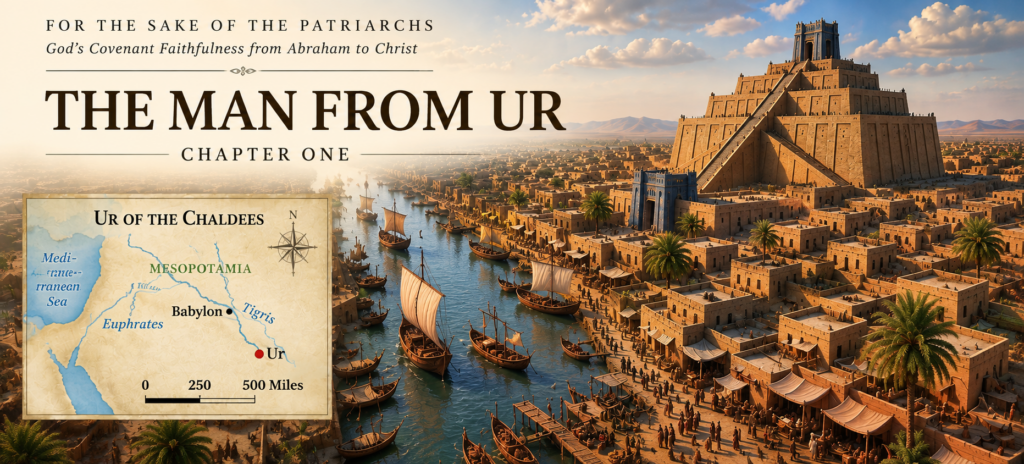
Ur stood in southern Mesopotamia, in the fertile country watered by the Euphrates and Tigris Rivers, in what is now southern Iraq. To the modern reader, the name may suggest a remote settlement emerging from the mists of biblical antiquity.
The archaeological record presents a very different picture.
Ur was a substantial urban center with monumental buildings, crowded residential districts, temples, workshops, merchants, scribes, craftsmen, priests, and administrators.
This was Abraham’s world.
By the beginning of the second millennium BC, Ur already possessed a history stretching back many centuries. Kings had built monuments, armies had marched, merchants had accumulated fortunes, and generations had lived and died within its walls. Kingdoms had risen and fallen there.
The city was connected through rivers, canals, and trade routes to a world extending far beyond southern Mesopotamia. Boats moved along its waterways. Merchants maintained accounts. Laborers loaded cargo. Craftsmen worked in workshops. Scribes pressed wedge-shaped characters into wet clay tablets, recording transactions that no one could have imagined would still be read thousands of years later.
Some of those tablets have survived.
They provide an extraordinary window into the world behind the biblical narrative. Contracts, receipts, inventories, property transactions, administrative records, school exercises, and legal documents testify to a society considerably more sophisticated than the primitive world we sometimes imagine when reading Genesis.
People bought and sold property. They borrowed money. They settled disputes. They entered contracts. They calculated quantities and recorded debts.
Ur was not merely ancient. It was civilized.
And Abraham belonged to that world.
He did not begin his story among scattered tents in a barren wilderness. Nor was he raised among the descendants of Moses or David, for the nation of Israel did not yet exist. Abram’s beginnings were associated with a highly developed Mesopotamian civilization—a world of cities, commerce, writing, temples, wealth, and many gods.
That matters.
When we encounter Abraham later in Genesis, he is a man on the move. He pitches tents, builds altars, tends flocks, and journeys through lands that do not yet belong to him. It is easy to allow that image to become the whole picture.
It wasn’t.
Behind the tent stood the city.
Behind the shepherd stood a man whose beginnings were associated with one of the great urban civilizations of the ancient world.
And behind the journey toward Canaan stood a place called Ur.
Before we follow Abram out of that city, we should spend a little more time walking its streets.
The World Abraham Knew