
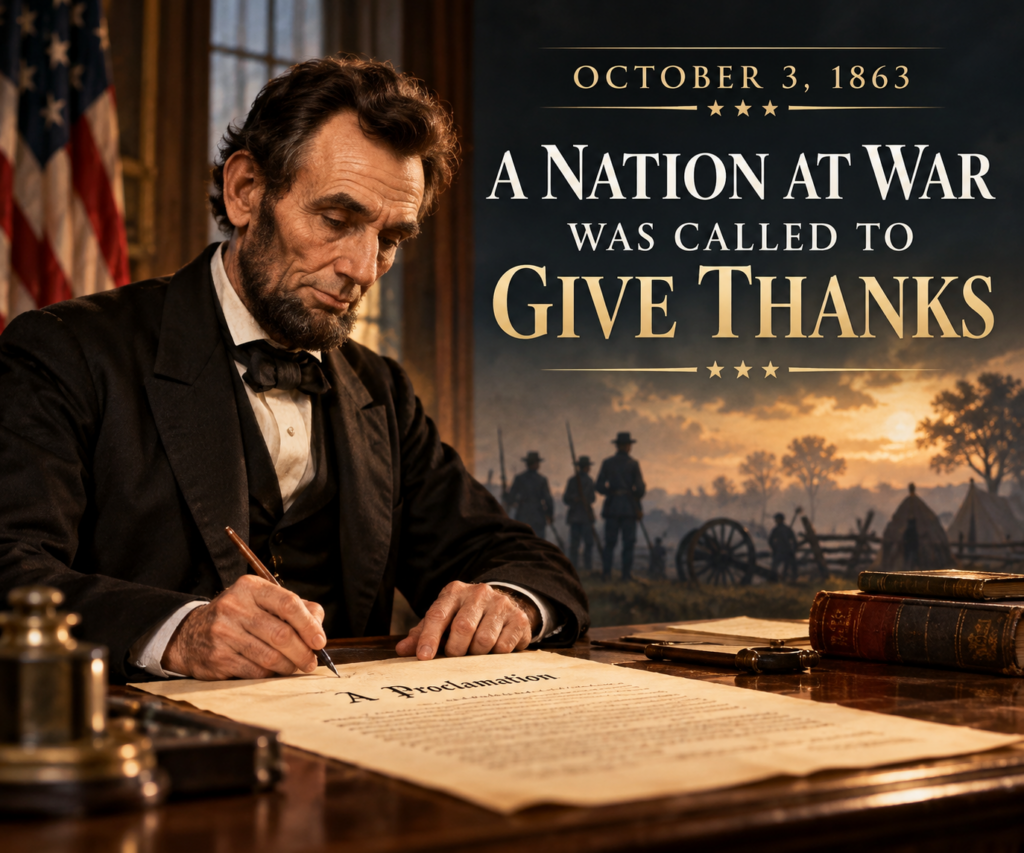
October 3, 1863
America was at war with itself.
By October 1863, the Civil War had been raging for more than two years. Gettysburg had been fought only three months earlier. Tens of thousands of Americans had been killed, wounded, or captured there. Families across both North and South were grieving, and there was no certainty about when—or how—the conflict would end.
It hardly seemed a time for thanksgiving.
Yet on October 3, 1863, President Abraham Lincoln issued one of the most remarkable proclamations of his presidency. He called upon Americans to set aside the last Thursday of November as a national day of Thanksgiving.
Thanksgiving itself was not new. Americans had observed days of thanksgiving since colonial times, and George Washington had issued a national Thanksgiving proclamation in 1789. But observances varied from state to state and from year to year.
One woman had spent years trying to change that.
Sarah Josepha Hale, the influential editor of Godey’s Lady’s Book, had long advocated for a common national Thanksgiving. On September 28, 1863, she wrote to Lincoln, urging him to establish what she called a great national “Union Festival.”
Five days later came Lincoln’s proclamation.
But Lincoln did something more profound than simply establish a date on the calendar. He asked Americans to look beyond the war.
Even during a year of terrible bloodshed, he pointed to fruitful fields, healthful skies, continued commerce, expanding settlements, and a growing population. The blessings of ordinary life had continued even while the nation was tearing itself apart.
Lincoln attributed those blessings not to government or national greatness, but to God.
There was something deeper in that acknowledgment. Americans had planted the fields, built the towns, worked the factories, and expanded the nation, but they had not created the soil, the seasons, the rain, or the circumstances that allowed those efforts to prosper. In a year when Americans had demonstrated how much human beings could destroy, Lincoln was asking them to remember how much they had been given.
He called upon Americans to acknowledge them “with one heart and one voice.” And then the proclamation took an unexpected turn.
Lincoln did not call merely for celebration. He called for humility.
Along with thanksgiving, Americans were urged to remember the widows, orphans, mourners, and others suffering because of the war. The nation was also called to penitence for its own wrongdoing and to pray for the healing of its wounds.
That may be the most striking part of the proclamation.
Lincoln was speaking as commander in chief during a civil war. Yet his Thanksgiving message was not principally a celebration of victory over an enemy. It was an invitation for Americans to recognize blessings they had not created, acknowledge failures of their own, care for those who were suffering, and seek restoration of the nation.
The proclamation concluded with a prayer that the country might again enjoy:
“peace, harmony, tranquillity and Union.”
The first Thanksgiving under Lincoln’s proclamation was observed on Thursday, November 26, 1863.
Just one week earlier, Lincoln had stood on a battlefield in Pennsylvania and delivered another short message to the nation.
We remember that one as the Gettysburg Address.
But his Thanksgiving proclamation deserves remembering too.
Because in one of the darkest years in American history, Lincoln reminded a wounded nation that gratitude does not require perfect circumstances.
Sometimes it is needed most when circumstances are anything but perfect.