
The Day the British Empire Lost America
October 19, 1781 — A Victory That Changed the World
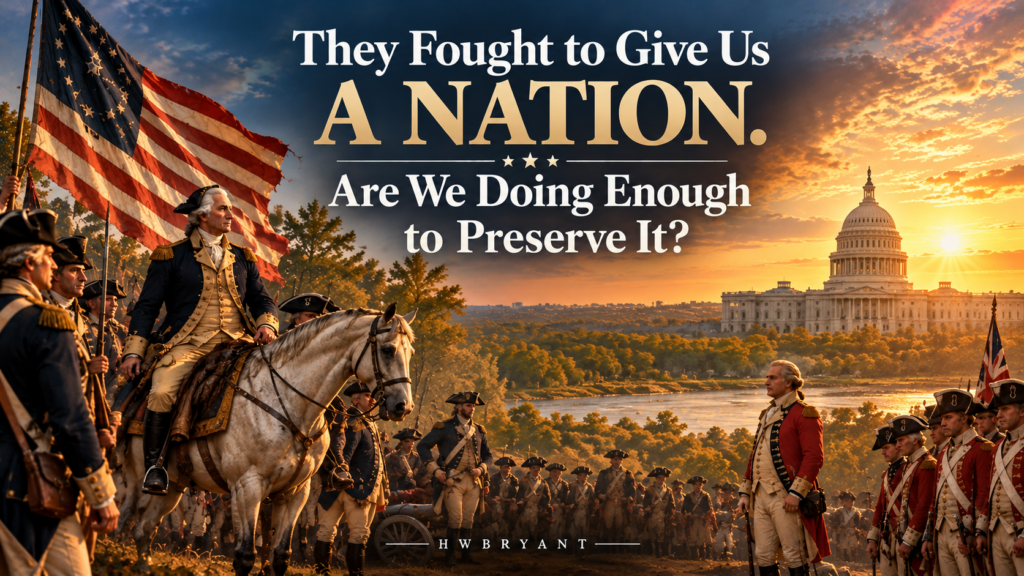
On October 19, 1781, an extraordinary scene unfolded near the small Virginia town of Yorktown. Soldiers of the British Empire, representing one of the world’s greatest military powers, marched between victorious American and French troops and laid down their arms.
For General George Washington, it was the culmination of six years of sacrifice, disappointment, endurance, and unwavering determination. For the thirteen American colonies, it was the decisive turning point in their struggle for independence.
But history would reveal that something far greater had happened that October afternoon.
A nation was emerging that would eventually become one of the most influential powers in human history. Its principles of constitutional government, individual liberty, and national sovereignty would inspire generations far beyond its shores.
And standing at the center of that extraordinary moment was a man who believed that victory depended upon more than military strength and human wisdom.
Washington believed in Divine Providence.
A Victory Against Extraordinary Odds
The American Revolution was never a foregone conclusion.
Britain possessed a professional army, a powerful navy, considerable financial resources, and an empire extending across the globe. Washington commanded an army frequently short of food, clothing, ammunition, and money. His soldiers endured brutal winters, repeated defeats, and years of uncertainty.
Yet Washington persevered.
His greatness was not simply that he won battles. Indeed, he lost several. His remarkable achievement was keeping an army together long enough for independence to become possible. By the autumn of 1781, circumstances had begun to favor the Americans.
With the assistance of French General Rochambeau and Admiral de Grasse, Washington executed a campaign that trapped British General Charles Cornwallis at Yorktown. French naval forces prevented British reinforcements from reaching the besieged army, while American and French troops tightened their grip on land.
Even the weather played a remarkable part. On the night of October 16, a sudden storm disrupted Cornwallis’s attempt to evacuate troops across the York River. Three days later, the British surrendered.
The war would not formally end until 1783, but the defeat at Yorktown had made Britain’s effort to subdue the colonies increasingly untenable.
The American experiment would survive.
The General Who Believed in Providence
Washington was a man of military discipline, practical judgment, and considerable personal courage. But his writings also reveal a profound conviction that human affairs unfolded under the watchful authority of Providence.
Less than a month after Yorktown, Washington wrote to Thomas McKean, president of Congress, acknowledging:
“the interposing Hand of Heaven … has been most conspicuous & remarkable”
He was referring specifically to the preparations and circumstances that had made the Yorktown victory possible.
Washington did not consider Providence a substitute for planning, courage, or personal responsibility. Rather, he saw God’s hand working through circumstances beyond human control.
The day after the British surrender, he ordered services of thanksgiving throughout the army, urging his soldiers to recognize the extraordinary interventions of Providence they had witnessed. For Washington, gratitude was not merely a private sentiment. It was an obligation. And for those who share his faith, the remarkable survival of the American Revolution raises a question that reaches beyond military history.
Was this simply the fortunate outcome of human determination and international circumstances, or was a greater purpose unfolding through those events?
More Than the Birth of a Nation
The men who fought at Yorktown could scarcely have imagined what the United States would become.
They were fighting for independence and the right to determine their own political future. Yet the nation that emerged would eventually extend from the Atlantic to the Pacific, develop into an extraordinary center of industry, commerce, science, and innovation, and become a decisive participant in world affairs.
Its constitutional experiment would influence political institutions far beyond North America.
Its economic achievements would transform international commerce. Its inventors, entrepreneurs, and scientists would contribute discoveries that changed everyday life across the world.
In the twentieth century, American involvement would prove decisive in two world wars. The United States would help rebuild devastated nations, support international institutions, and play a central role in the struggle against Soviet communism.
The country born from that improbable victory would eventually send human beings to the moon.
America’s history has not been without serious failures or injustices. Yet its founding principles have also provided the means through which generations have challenged those failures and sought to bring the nation closer to its declared ideals.
The American story is not one of perfection. It is a story of extraordinary achievement, continuing responsibility, and the enduring possibility of improvement.
Providence, Patriotism, and Responsibility
In June 1783, as Washington prepared to relinquish military command, he addressed the governors of the states in a remarkable circular letter. Reflecting upon America’s independence, he wrote of the nation’s opportunity for political happiness, observing that Providence had placed its citizens in an extraordinary position.
But Washington understood that such an inheritance brought responsibilities.
He concluded his letter with a prayer that God would guide the American people toward justice, mercy, charity, and humility, warning that without those qualities they could never hope to be a happy nation.
Here was the victorious commander of the Revolution, not boasting of conquest or national superiority, but reminding his countrymen of their moral obligations. Perhaps that is one of the most important lessons Yorktown offers America today.
National greatness is not simply measured by military strength, economic prosperity, or international influence. It also depends upon the character of its people, the preservation of liberty, and the willingness of each generation to accept responsibility for what it has inherited.
Patriotism should inspire gratitude for the nation’s achievements, humility concerning its failures, and determination to preserve what is worthy of passing to future generations.
A Victory Whose Consequences Are Still Unfolding
When the British laid down their arms at Yorktown, they could not have known how profoundly the world would change.
They witnessed the defeat of an army. History would reveal the emergence of a nation.
Two hundred and forty-five years later, the United States stands as a remarkable testament to what can grow from courage, conviction, sacrifice, and a commitment to liberty.
And perhaps there is an even greater question worth considering.
If Washington believed that Providence had guided his struggling nation through its darkest hours, what responsibility does that place upon the generations who inherited its freedom?
The victory at Yorktown was not simply the end of a British campaign. It was the beginning of an American future whose influence would be felt around the world.
And perhaps the most fitting tribute we can offer those who secured that future is not merely to celebrate the nation they gave us, but to prove ourselves worthy of preserving it.