
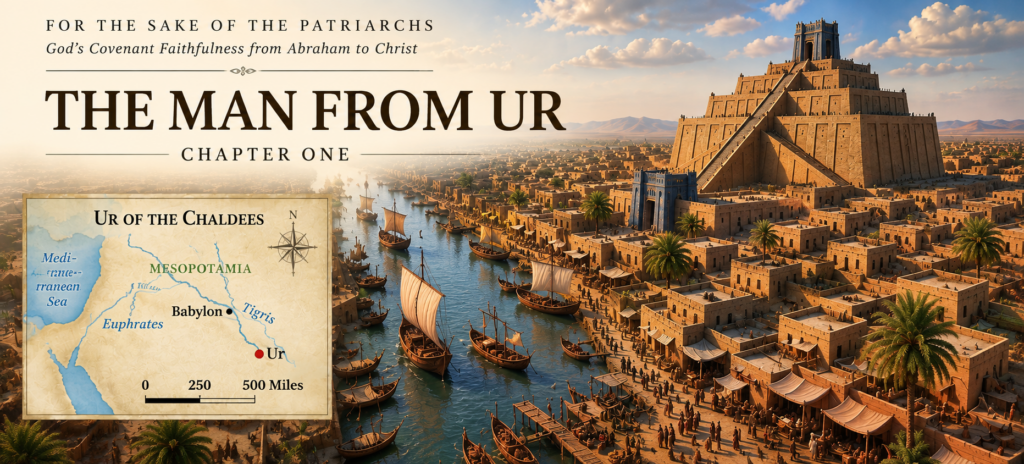
03 — THE CITY OF THE MOON GOD
For the Sake of the Patriarchs
Chapter One: The Man From Ur
There was something about ancient Ur that could hardly have escaped the attention of those who lived there.
Rising above its houses, workshops, and crowded streets stood an enormous structure of mudbrick, built to honor a god believed to watch over the city.
It was the Great Ziggurat of Ur.
Its massive terraces and stairways dominated the surrounding landscape, proclaiming something about the people who built it. For all their achievements in commerce, architecture, and learning, the inhabitants of Ur understood their world through the presence and power of their gods.
And chief among those gods was Nanna, also known as Sin—the moon god.
The Great Ziggurat
Around the end of the third millennium BC, King Ur-Nammu undertook an ambitious building program that included the great ziggurat dedicated to Nanna.
Constructed around a core of mudbrick and faced with baked bricks, the monument rose in successive terraces, approached by monumental stairways. Its upper levels formed part of a sacred complex associated with the city’s patron deity.
Much of the original structure has disappeared, but its surviving foundations and reconstructed lower portions still convey something of its extraordinary scale.
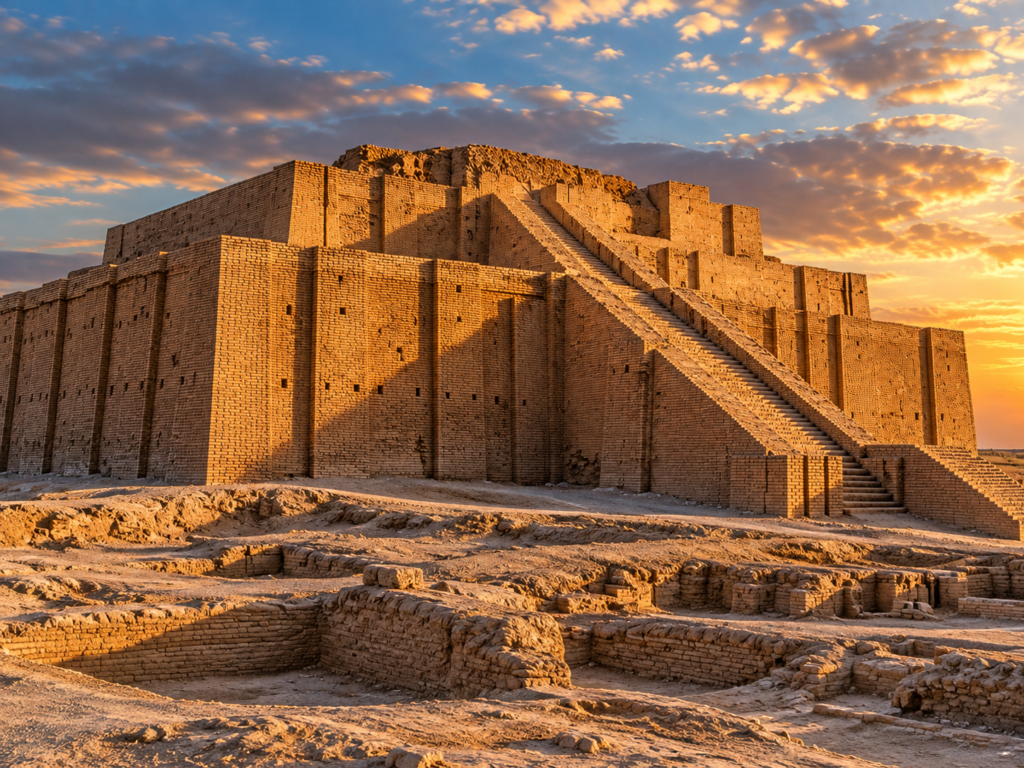
Imagine approaching Ur from the surrounding countryside. Long before reaching the narrow streets and crowded neighborhoods, a traveler would have seen the great structure rising above the city. It was more than an impressive building. It represented the relationship between the people of Ur and the divine powers they believed governed their existence.
A World Filled With Gods
The religion of ancient Mesopotamia was not confined to a particular day of worship or a single sacred building. It reached into almost every part of life.
Temples possessed land, employed workers, received offerings, and participated in the economic affairs of the city. Priests and temple administrators held significant responsibilities, while religious festivals marked the calendar.
Kings sought the favor of the gods. Farmers depended upon fertile fields and favorable seasons. Merchants faced the uncertainties of travel, while families experienced sickness, childbirth, marriage, prosperity, and loss.
All of these belonged to a world in which divine powers were believed to influence human affairs.
Nanna was the principal deity of Ur, but he was not the only god worshipped in Mesopotamia. The people recognized numerous deities associated with the heavens, storms, fertility, wisdom, justice, and war.
Religion was not merely something the people of Ur practiced. It was part of how they understood the world.
Before Abraham Knew the God of the Covenant
Generations after Abram left Mesopotamia, Joshua gathered the tribes of Israel and reminded them of their origins.
He began not with their deliverance from Egypt, nor even with the promises made to Abraham, but with the religious background of their ancestors.
“Your fathers dwelt on the other side of the flood in old time, even Terah, the father of Abraham, and the father of Nachor: and they served other gods.”
— Joshua 24:2 (KJV)
Here, the expression the other side of the flood refers to the region beyond the Euphrates River.
Joshua’s statement is striking.
The family from which Israel would emerge had not always worshipped the God who would establish His covenant with Abraham.
They had served other gods.
Scripture does not tell us precisely which deities Terah or Abram worshipped. We cannot simply assume that because Nanna was the principal deity of Ur, every member of Terah’s household was devoted to him.
But we can recognize the religious environment in which the family lived. The worship of many gods was woven into the culture of their homeland. And from that world would emerge the man through whom God intended to accomplish something extraordinary.
Abraham’s story does not begin with a nation already devoted to the God of Israel. There is no Moses, no Sinai, no tabernacle, and no established covenant nation.
There is a man living within a civilization that understands the divine world very differently from the faith that will eventually bear his name.
And somewhere within that world stands the household of Terah.
It is time we met them.
NEXT: 04 — The House of Terah →