
04 — The House of Terah
For the Sake of the Patriarchs
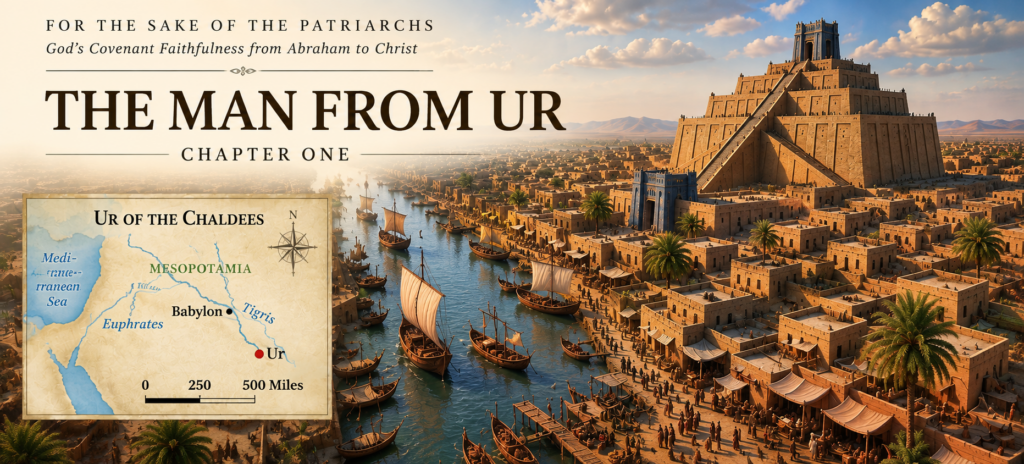
Chapter One: The Man From Ur
Among the families living in Ur was the household of Terah, a descendant of Shem through the line of Arphaxad. Scripture tells us little about the man himself but introduces three sons whose family relationships would become important in the unfolding story.
Their names were Abram, Nahor, and Haran.
Abram is listed first, although this does not necessarily mean he was the eldest. In biblical genealogies, the order of names sometimes reflects their importance to the narrative rather than their order of birth.
Haran became the father of Lot, Milcah, and Iscah. Nahor married Milcah, his niece, while Abram married Sarai, whose family relationship would become clearer later in the story.
These were ordinary family relationships in a world where the extended household provided identity, security, and continuity. But two circumstances would distinguish this family as the narrative developed.
The first was the death of Haran.
Genesis 11:28 tells us that Haran died in Ur while his father Terah was still alive. Scripture provides no explanation of his death or the circumstances surrounding it.
A father had outlived his son, and three children had lost their father.
Among them was Lot, whose relationship with his uncle Abram would become an important part of the story. For now, however, we simply meet him as a member of a family marked by loss.
But Haran’s death was not the only circumstance casting uncertainty over the family’s future. The second circumstance concerned Abram and Sarai.
“But Sarai was barren; she had no child.” (Genesis 11:30, NKJV)
It is a brief statement, but one that will carry enormous significance.
In a society where children ensured the continuation of the family line, the absence of an heir presented an uncertain future. At this point in the story Scripture offers no explanation and makes no promise that Sarai’s circumstances would change.
For Abram and Sarai, there was simply no child. Yet readers familiar with what follows will recognize that this single sentence introduces a question that will remain unresolved for many years.
Then, almost without warning, the narrative takes an unexpected turn.
Terah gathered Abram, Sarai, and his grandson Lot and departed from Ur of the Chaldeans. Their intended destination was Canaan.
Genesis 11:31 tells us that they set out for Canaan, but when they reached Haran, they settled there. Why had Terah decided to leave Ur? Why was Canaan their destination? And why did they stop in Haran? Scripture does not explain.
We know only that Terah remained in Haran, where Genesis records his death at the age of 205.
The family had left its ancestral home, but the journey to Canaan remained unfinished.
Haran was dead. Lot had accompanied his grandfather and uncle. Abram and Sarai remained without children. And Terah had settled short of the destination he had originally intended to reach.
What appeared to be an ordinary family migration was about to become part of something extraordinary.
But why had the journey begun in the first place?
The answer would change the course of biblical history.
NEXT: 04 — The Call→