
06 — Get Out of Your Country
For the Sake of the Patriarchs
Chapter Two: The Call
“Get thee out of thy country, and from thy kindred, and from thy father’s house, unto a land that I will shew thee.”
— Genesis 12:1
It was an extraordinary command.
God was asking Abram to leave behind almost everything that gave a man his place in the ancient world.
His country. His relatives. His father’s household.
For Abram, these were not simply matters of geography or personal attachment. Family determined a man’s identity, provided security, and established his place within the community. The household was the center of economic life, inheritance, religious traditions, and obligations that extended across generations.
To leave one’s father’s house was no small undertaking.
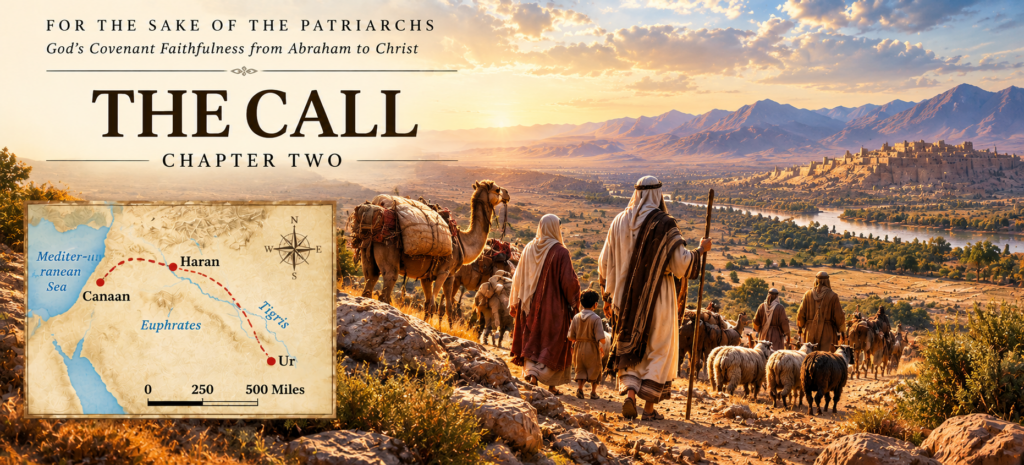
Abram had grown up in Ur, a prosperous city with established institutions and ancient religious traditions. His family had subsequently travelled to Haran, another important center of commerce and worship.
Now God was calling him beyond the familiar world of his ancestors. But notice something particularly interesting about the command.
God did not identify the destination.
He simply promised to show Abram the land.
There was no description of its cities, its inhabitants, or the conditions Abram would encounter. No assurance that the journey would be comfortable or that the land would immediately provide everything his household needed.
Abram was called to act on a promise before knowing its details.
Centuries later, the writer of Hebrews would reflect upon this remarkable decision:
“By faith Abraham, when he was called to go out into a place which he should after receive for an inheritance, obeyed; and he went out, not knowing whither he went.”
— Hebrews 11:8
Yet there is another aspect of God’s command worth considering.
What did it mean to leave his father’s house?
In the ancient world, belonging to a household involved more than living under the same roof. It meant participating in the authority, traditions, loyalties, and future of the family.
God’s command may therefore have involved something more profound than physical separation. Abram was being called into a new allegiance, one in which his future would no longer be determined primarily by the household from which he came.
Centuries later, Christ would make a remarkably similar demand of those who followed Him. He declared that even the closest family relationships must not take precedence over allegiance to Him (Matthew 10:37). Like Abram, His disciples were being called to a commitment that reached beyond the familiar securities of family, possessions, and established ways of life.
The circumstances were different, but the underlying question was much the same: to whom would they give their highest allegiance?
But the biblical account leaves us with an interesting complication.
Terah had accompanied the family’s departure from Ur, and Lot, Abram’s nephew, would continue with him toward Canaan. How were these family relationships to fit within God’s command to leave his kindred and his father’s house?
Genesis does not immediately explain.
What it does make clear is that Abram’s life was about to take a very different direction.
He was being asked to exchange the security of what he knew for the promise of something he had not yet seen.
And the God who called him had much more to say.
NEXT WEEK: : I Will Make of Thee a Great Nation.