
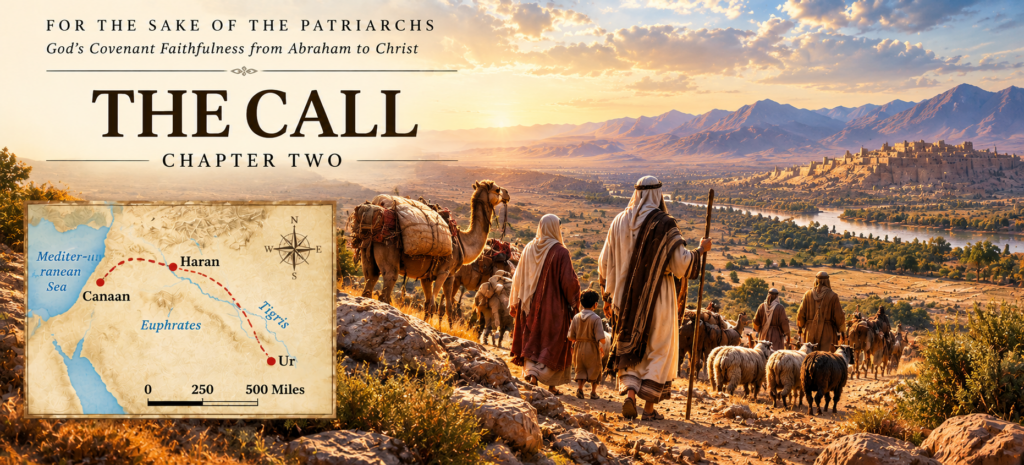
07 – The Promise and the Journey
For the Sake of the Patriarchs
Chapter Two: The Call
God had commanded Abram to leave his country, his kindred, and his father’s house. But the command was accompanied by an extraordinary promise.
“And I will make of thee a great nation, and I will bless thee, and make thy name great; and thou shalt be a blessing.”
— Genesis 12:2
There was an immediate difficulty.
Abram had no children, and Sarai, his wife, was barren. Yet God was promising to make him the father of a great nation.
But God’s declaration did not depend upon what Abram could presently accomplish.
“I will make of thee a great nation.”
And the promise went further.
“And I will bless them that bless thee, and curse him that curseth thee: and in thee shall all families of the earth be blessed.”
— Genesis 12:3
What did it mean for Abram to be a blessing?
God was promising more than personal prosperity or a distinguished family name. Abram was being called into a purpose that extended beyond himself. The blessing he received was somehow intended to reach others.
And the next words made that purpose even more extraordinary.
“And in thee shall all families of the earth be blessed.”
— Genesis 12:3
Not simply Abram’s household or the descendants who would eventually bear his name, but peoples and nations far beyond anything he could have imagined.
Yet God did not explain how this would happen. Would Abram bring blessing through his own actions? Through the nation that would descend from him? Or through something that would emerge much later in his family’s history?
For now, the promise remained unexplained.
What mattered was what Abram did next.
“So Abram departed as the Lord had spoken to him, and Lot went with him. And Abram was seventy-five years old when he departed from Haran. Then Abram took Sarai his wife and Lot his brother’s son, and all their possessions that they had gathered, and the people whom they had acquired in Haran”
— Genesis 12:4-5
This brings us to an interesting question. Who are these people Abram had acquired?
We do not know how long Abram and his family lived in Haran. But this was no temporary encampment along the road to Canaan. Possessions had been accumulated, people had joined the household, and a life had been established. The journey Terah had begun toward Canaan had become, at least for a time, a settled existence in Haran.
So while Genesis does not tell us how these people came to join Abram’s family, we can assume some were likely servants, workers, and other dependents who had become part of his growing household. An interesting Jewish tradition suggests that some were people Abram and Sarai had brought to worship their God, although Scripture does not establish that interpretation.
Whatever their origins, Abram was not travelling alone. His calling had set an entire community in motion.
We can imagine the company stretching along the ancient routes southwest from Haran. Herdsmen guided their animals across the open plains, while servants and family members travelled with the supplies and belongings necessary for the journey. Sheep and goats may have formed part of the flocks, with larger animals carrying loads or accompanying the herds.
The landscape changed as they travelled. The rolling country of northern Mesopotamia gave way to the valleys and grasslands of Syria, and eventually to the more rugged hills of Canaan. Along the way, the availability of water and pasture would have determined where the household could rest and how quickly it could move.
This was not a journey measured simply by the distance between two places. Every day’s progress depended upon the needs of the people and animals travelling together. Scripture does not tell us which route Abram followed or how long the journey took. It simply records:
“And they went forth to go into the land of Canaan; and into the land of Canaan they came. And the Canaanites were then in the land.”
— Genesis 12:5-6
Abram passed into the area of Shechem where a landmark known as the Oak of Moreh stood. The Hebrew name is intriguing, for Moreh is associated with teaching or instruction. Some scholars have suggested that the tree may have marked a place where people sought religious guidance. Prominent trees often held religious significance in the ancient world, and this location would become part of a region closely associated with important events in Israel’s later history.
But for Abram, the significance of the place was about to become unmistakable. Here, in a land already inhabited by the Canaanites, the Lord appeared to him and declared:
“Unto thy seed will I give this land.”
The man who had been promised a nation still had no child. And the land now promised to his descendants was already occupied.
NEXT – A Famine in the Promised Land