
This Week in American History | October 14, 1912
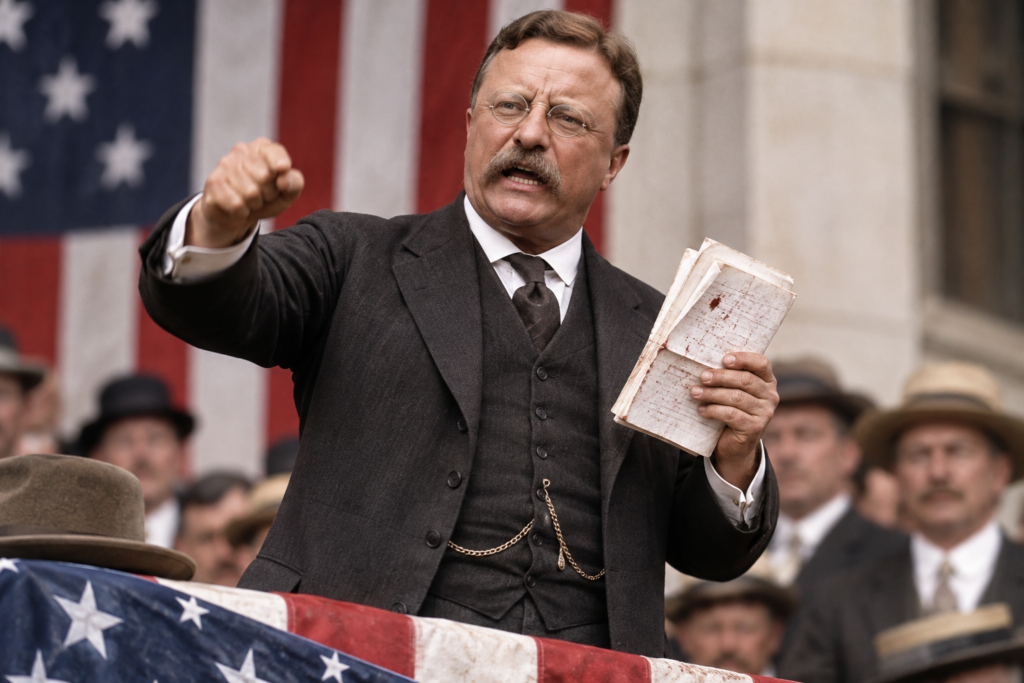
The bullet passed through Roosevelt’s steel eyeglass case and a thick, folded manuscript of the speech he intended to deliver before entering his body.
For most men, the campaign would have ended there. For Theodore Roosevelt, the evening was only beginning.
A President Who Refused to Retire
Roosevelt had already served nearly eight years as president, assuming office following the assassination of William McKinley in 1901 and winning election in his own right in 1904.
By 1912, he had become dissatisfied with the direction of the Republican Party under his successor, William Howard Taft. Roosevelt believed the federal government needed to take a more active role in confronting powerful corporate interests, protecting workers, and addressing the consequences of America’s rapid industrial growth.
When Taft secured the Republican nomination, Roosevelt broke with the party and helped establish the Progressive Party, popularly known as the Bull Moose Party.
The election became an unusual four-way contest involving Taft, Roosevelt, Democrat Woodrow Wilson, and Socialist Eugene V. Debs.
Roosevelt understood that his campaign was an uphill battle, but he was determined to make his case directly to the American people.
That determination brought him to Milwaukee.
The Shot Outside the Hotel
The gunman was John Flammang Schrank, a New York saloonkeeper who had become convinced that Roosevelt’s pursuit of another presidential term was dangerous. Schrank later claimed that the spirit of the assassinated President McKinley had instructed him to stop Roosevelt.
As Roosevelt emerged from the hotel, Schrank fired a single shot.
The crowd immediately seized the gunman, but Roosevelt intervened to prevent them from attacking him. Despite his wound, he questioned Schrank briefly before instructing that he be turned over to the police.
Roosevelt then assessed his own injury. An experienced outdoorsman and hunter, he knew that coughing blood could indicate serious lung damage. Finding no blood in his cough, he concluded that the wound might not be immediately fatal.
It was a dangerous judgment to make without medical examination, but Roosevelt had already decided what he would do next.
He was going to deliver his speech.
Ninety Minutes That Became History
When Roosevelt arrived at the Milwaukee Auditorium, those around him urged him to seek medical attention. He refused.
Standing before an astonished audience, he announced:
“I don’t know whether you fully understand that I have just been shot; but it takes more than that to kill a Bull Moose.”
He then displayed the bullet-damaged manuscript, explaining that the folded pages had probably prevented a more serious injury.
For approximately ninety minutes, Roosevelt continued speaking, his shirt stained with blood and the bullet still lodged in his chest.
Yet perhaps the most remarkable feature of the evening was not simply that Roosevelt continued speaking. It was what he chose to say.
Rather than dwelling on his attacker, Roosevelt warned Americans about the dangers of political and economic division. He feared that growing resentment between wealthy and poorer citizens could eventually produce a society in which violence replaced reasoned disagreement.
His argument was that government should address legitimate grievances before bitterness and hostility overwhelmed the country’s political institutions.
Roosevelt was certainly no stranger to fierce political combat. He could be stubborn, combative, and uncompromising. Nevertheless, on an evening when he had every reason to speak angrily, he attempted to turn an act of violence into an appeal for national responsibility.
The title later associated with the address captured his central argument: The Progressive Cause Is Greater Than Any Individual.
The Election That Changed American Politics
Following the speech, Roosevelt was taken to a hospital, where physicians determined that the bullet had not penetrated his lungs. Removing it was considered more dangerous than leaving it in place, and Roosevelt carried the bullet for the remainder of his life.
He survived the assassination attempt, but his remarkable performance in Milwaukee could not deliver victory in November.
Woodrow Wilson won the presidency with approximately 42 percent of the popular vote. Roosevelt finished second, ahead of the incumbent president, William Howard Taft.
The division between Roosevelt and Taft had fractured the Republican vote, helping Wilson secure the White House.
Roosevelt’s Progressive Party did not survive as a lasting national political force, but several of its reform proposals continued to influence American politics.
Courage, Conviction, and Leadership
It would be easy to remember the Milwaukee incident simply as an extraordinary display of physical courage. Certainly, few political figures have demonstrated such determination under circumstances so dangerous.
But Roosevelt’s actions also invite a broader reflection on leadership.
He had already achieved the nation’s highest office. He possessed wealth, international recognition, and an established place in American history. Yet he believed that important questions concerning the nation’s future remained unresolved.
Whether Americans agreed with his political philosophy was another matter. Many questioned his desire for a third presidential term, his approach to federal power, and his willingness to divide his former party.
Those disagreements were legitimate parts of the democratic process.
But the attempt on his life raised a different question: Could Americans disagree passionately about their country’s direction without treating political opponents as enemies to be destroyed?
More than a century later, that question remains relevant. America’s constitutional system depends not only on elections and political institutions but also on citizens willing to accept disagreement, respect lawful outcomes, and reject political violence.
Theodore Roosevelt did not win the election of 1912. His political judgment was not infallible, nor were all his policies universally admired.
But on one October evening in Milwaukee, he demonstrated a quality Americans have long admired in their leaders: the determination to carry on when circumstances offer every reason to surrender.
The bullet stopped in Roosevelt’s chest.
The speech, however, went on.