
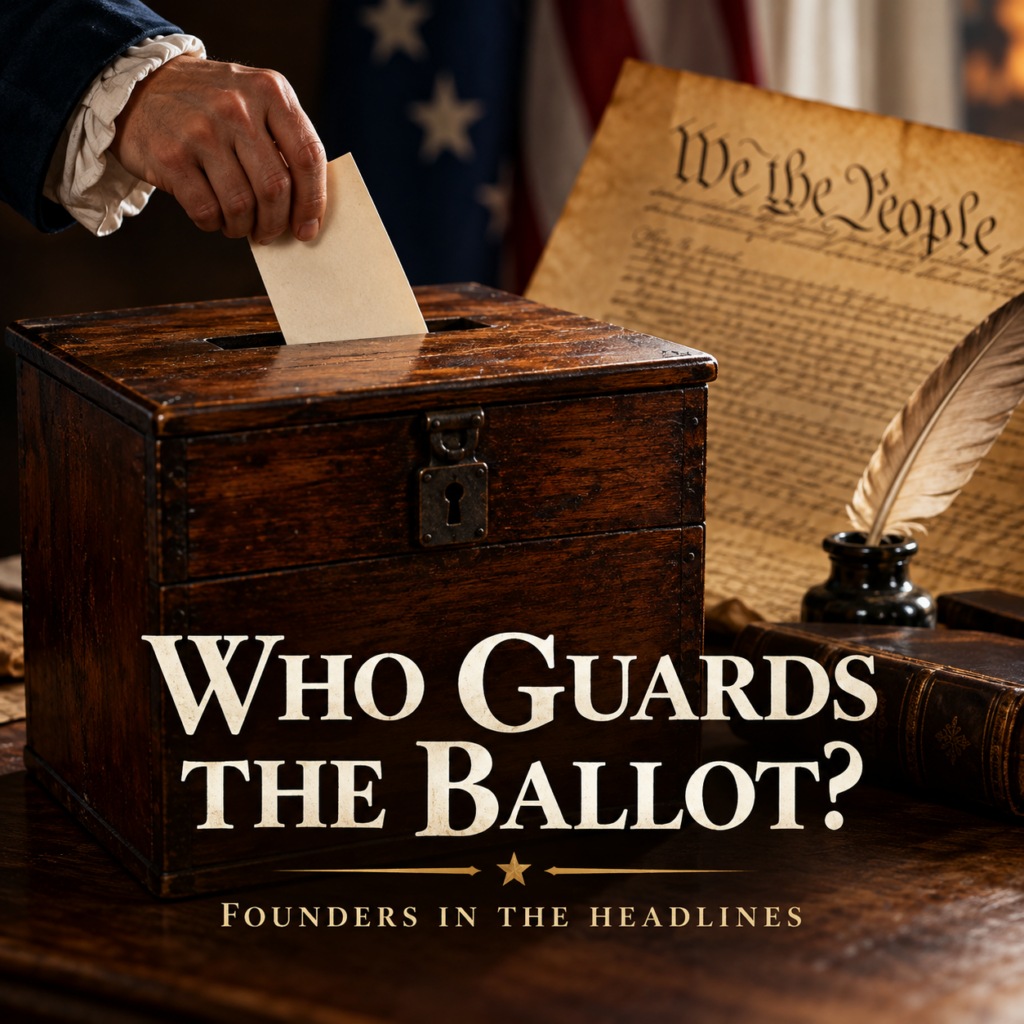
Election Integrity and the Founders’ Expectations of Government
Founders in the Headlines | October 16, 2026
Should the accuracy of America’s voter rolls be a partisan issue? Surely, regardless of political allegiance, every citizen has an interest in ensuring that elections are conducted fairly, that only eligible voters participate, and that no eligible citizen is denied the opportunity to vote.
Yet voter registration has become another subject of political disagreement, raising a constitutional question that reaches back to the founding of the Republic: Who is responsible for safeguarding the ballot, and how should that responsibility be exercised?
A Dispute in California
On October 15, the United States Department of Justice filed a lawsuit against California, alleging that more than 20,000 individuals identified as likely noncitizens were registered to vote. Federal officials argue that the state has failed to take appropriate action to investigate the registrations.
California officials dispute the reliability of the allegations and question the federal government’s authority and methods. The identities and eligibility of those flagged have not been conclusively established.
Behind the disagreement lies a question that should concern Americans of every political persuasion: Why should maintaining accurate voter registration records be controversial?
The Founders and the Responsibility for Elections
The framers of the Constitution understood that elections were essential to the legitimacy of representative government. They also recognized the danger of placing excessive authority over elections in any single institution.
Article I, Section 4 of the Constitution assigned responsibility for regulating congressional elections primarily to the states, while reserving to Congress the authority to make or alter those regulations.
Alexander Hamilton defended this arrangement in Federalist No. 59, arguing that the national government needed sufficient authority to protect the continuation of its representative institutions.
Hamilton was concerned that leaving the federal government entirely dependent upon the states for the election of its representatives could threaten the functioning of the Union itself.
The constitutional arrangement therefore reflected a deliberate balance: state responsibility accompanied by a measure of federal oversight.
Neither level of government was intended to exercise unlimited authority.
Does the Size of the Problem Matter?
Consider an ordinary example. A business discovers that merchandise is being stolen from its shelves. Would we argue that shoplifting should be ignored because the losses are too small to threaten the business’s survival?
Of course not. The obligation to uphold the law does not depend upon whether its violation produces a catastrophic result.
The same principle deserves consideration in elections.
An unlawful vote does not become acceptable merely because it fails to change an election outcome. Likewise, improperly preventing a qualified citizen from voting does not become acceptable because the election result remains unchanged.
There is, however, an important distinction between an outdated registration, an ineligible registration, and an illegally cast ballot. Each requires appropriate verification rather than assumption.
Maintaining accurate voter rolls should therefore be a routine responsibility of election administration, not simply a reaction to allegations of widespread fraud.
Responsibility Without Partisanship
Voter registration records inevitably change. Citizens die, move between jurisdictions, change their names, or become newly eligible to vote. Maintaining those records requires cooperation between government agencies, reliable information, and established procedures.
Federal law also establishes safeguards against erroneous removals. These protections are particularly important when databases contain incomplete or outdated information. But safeguards and accuracy need not be competing objectives.
A responsible system should be capable of identifying deceased registrants, investigating credible evidence of ineligibility, correcting administrative errors, and protecting lawful voters from improper removal.
The disagreement should concern the reliability and legality of particular methods, not whether accurate records are desirable.
This is where the Founders’ understanding of government accountability becomes particularly relevant.
The Constitution divided governmental authority, but it did not relieve those entrusted with authority of the obligation to exercise it responsibly.
The Confidence of the People
Public confidence in elections cannot depend exclusively upon assurances that irregularities were too few to affect the result.
Confidence is also built through visible diligence, consistent procedures, transparent administration, and the willingness of government officials to correct mistakes.
A citizen should be able to expect that election officials will investigate credible irregularities regardless of which political party might benefit from the outcome. That expectation should apply equally when a government agency seeks to remove an ineligible registration and when a citizen challenges an erroneous removal.
The Founders understood that representative government required more than the existence of elections. It required institutions capable of exercising authority within established constitutional limits.
Perhaps the question we should be asking is not whether voter-roll inaccuracies have changed an election, but whether every level of government is fulfilling its responsibilities to maintain the integrity of the process.
Accurate voter rolls should not be a Republican objective or a Democratic objective. They should be an American expectation.
And that expectation raises a final question worthy of the Founders themselves:
If public confidence is essential to representative government, should ensuring the accuracy of the ballot not be among government’s most ordinary and unquestioned responsibilities?
References